
Economy and power
Metal, power, selling and refunds: the numbers that decide how fast your base runs.
Steel Tide has two resources. Metal is what you spend; power decides how fast you can spend it.
Metal
- Metal comes only from extractors on deposits. A Metal Extractor mines 1.4 metal per second; the Advanced Extractor doubles that on the same deposit.
- There is no storage cap and no other income. Your economy is exactly the number of extractors you keep alive.
- Skirmish matches start with 300, 600, 1,200 or 2,500 metal, chosen in the setup screen.
| Weapon | Cost | Build time | Hit points | Power | Mining | Upgrade |
|---|---|---|---|---|---|---|
 | 2500 | 60 s | 4000 | +10 | — | — |
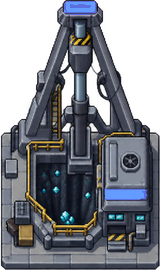 | 120 | 10 s | 600 | −4 | +1.4 | 240 metal · 16 s |
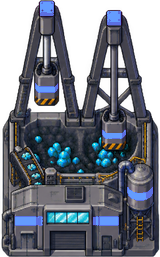 | 360 | 26 s | 950 | −8 | +2.8 | — |
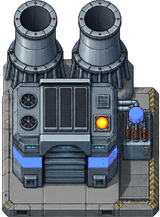 | 140 | 12 s | 500 | +20 | — | 260 metal · 18 s |
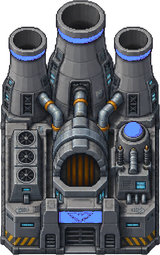 | 400 | 30 s | 900 | +60 | — | — |
Power
Power plants produce; everything else consumes. As long as production covers consumption nothing changes. The moment consumption exceeds production, the base runs at a power factor:
power factor = max(0.35, produced ÷ consumed)
The factor multiplies the speed of production, turret fire, mining and repair towers, and the Radar Station loses range. A base at 50 % power builds tanks at half speed and its turrets fire at half rate. The floor is 35 %, so a base never stops entirely, but a serious deficit costs more than any single building is worth.
Selling and refunds
- Selling a building returns half its cost, scaled by remaining health (never less than a quarter of that).
- Cancelling construction refunds 95 % of what has been paid so far.
- Cancelling production refunds what the unit in progress has consumed; units still waiting in the queue have cost nothing yet.
Population
Each unit costs population; the cap is 50, 100 or 200, set at match start. Heavier units cost more, so late in a game the cap nudges armies toward quality over quantity.
Repair
Engineers repair buildings and units they are ordered onto, and a Repair Tower heals everything allied in range automatically. Both slow down with the power factor, so a base in deficit also recovers slower between attacks.